A REVIEW AND IMPLICATIONS FOR THE MODEL FOR THE TREATMENT OF INDIVIDUALS WITH COMPULSIVE SEXUAL BEHAVIOR DISORDER
BY GRETCHEN BLYCKER, MA + MARC POTENZA,MD
Background and aims: Mindfulness-based approaches, derived from centuries of eastern philosophy and practice, have been increasingly incorporated into western medicine. For example, data support the efficacy of mindfulness- based therapies to reduce stress and promote mental health. Methods: In this study, we briefly review models and approaches to sexual health in the context of considering compulsive sexual behavior disorder, describe mindfulness- based approaches to stress, addiction, and compulsive sexual behaviors, and present a Mindful Model of Sexual Health (MMSH) that incorporates elements of eastern and western philosophies.
We further illustrate the clinical utility of the MMSH in a clinical case description. Results: We propose the MMSH as a holistic and integrative model that honors and acknowledges individual differences and provides mindfulness-based tools and practices to support individuals to proactively manage, balance, and promote sexual and mental health. The MMSH may be used as a framework to organize information regarding physical, mental, emotional, sexual, and relational health, as well as a conceptual map offering navigational skills to access information within one’s mind/body to make informed decisions to promote well-being regarding sexual satisfaction and health.
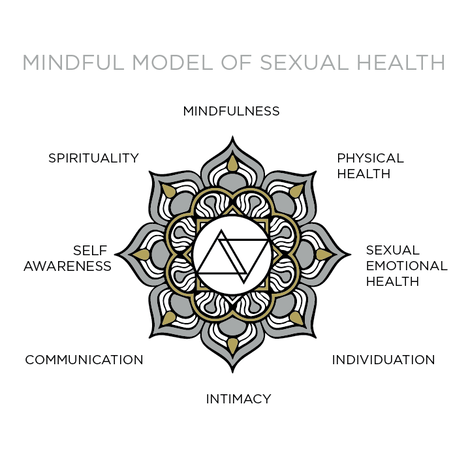
In its organizational structure, the MMSH is divided into eight domains that are theoretically linked to biological functions and may be used to identify and overcome barriers to sexual health through mindful inquiries in clinical practice or educational settings. Discussion and conclusion: Given its focus on awareness of interoceptive processes through mind/body connectedness, the MMSH may resonate with a wide range of individuals, including those with compulsive sexual behavior disorder.
We further illustrate the clinical utility of the MMSH in a clinical case description. Results: We propose the MMSH as a holistic and integrative model that honors and acknowledges individual differences and provides mindfulness-based tools and practices to support individuals to proactively manage, balance, and promote sexual and mental health. The MMSH may be used as a framework to organize information regarding physical, mental, emotional, sexual, and relational health, as well as a conceptual map offering navigational skills to access information within one’s mind/body to make informed decisions to promote well-being regarding sexual satisfaction and health.
In its organizational structure, the MMSH is divided into eight domains that are theoretically linked to biological functions and may be used to identify and overcome barriers to sexual health through mindful inquiries in clinical practice or educational settings. Discussion and conclusion: Given its focus on awareness of interoceptive processes through mind/body connectedness, the MMSH may resonate with a wide range of individuals, including those with compulsive sexual behavior disorder.
MINDFUL MODEL OF SEXUAL HEALTH
BY GRETCHEN BLYCKER, LMHC, LMT, CYT
Changes occurring over the last century have opened up opportunities and freedoms that have transformed the landscape of culture and different systems in many ways. As a result of these ongoing changes, our out- dated maps for navigating and promoting sexual wellbeing and healthy relationships are not necessarily as helpful as they may have been because they were developed to address past realities and norms. We need new ways of accessing direction for navigating throughout our lives in a manner that promotes health and balance within ourselves, in the setting of our continuously changing world. We need navigational systems and tools that are inclusive of all people and that allow for the complexities and individual differences of supporting the multiplicity of expressions of personal authentic sexual selves.
This mandala shaped model represents an individualized map for an inner journey of exploration, learning, and identifying all that contributes the unique landscape of a person’s mind/body/spirit in the context of their personal life. The Mindful Model of Sexual Health (MMSH) utilizes the chakra system, from Indian yoga, as a framework to organize the intricacies of the many influencing factors that create a balance towards, or barriers to, sexual wellness.
Holistic health requires that we are connected to our whole selves and the MMSH acknowledges our inherent wholeness and our interconnectivity. As a mindfulness-based model, mindful practices and inquiries are integrated throughout to develop skills to identify the subtle, complex, and myriad factors that influence psychological and sexual wellbeing, subjective satisfaction, sexual functioning, and contentment.
The organizing principles of the MMSH promote; respect-based sexuality, sexual and emotional safety free from exploitation, mindful connectedness, holistic sexual/mental/ physical health, and the integration of eastern/western perspectives and practices to promote mind/body/spirit health.
The MMSH is part of a toolkit that may be integrated into; developing a loving self-care plan, healing from sexual trauma, mindfully exploring sexual pleasures, identifying and managing healthy boundaries, creating healthy intimacy, practicing effective communication, increasing self-awareness, and living in alignment and harmony with one’s values and beliefs. There are simple tools to use to access one’s inner guidance system in order to make informed decisions for more immediate course correction that is advantageous for short and long- term contentment and well-being.
This mandala shaped model represents an individualized map for an inner journey of exploration, learning, and identifying all that contributes the unique landscape of a person’s mind/body/spirit in the context of their personal life. The Mindful Model of Sexual Health (MMSH) utilizes the chakra system, from Indian yoga, as a framework to organize the intricacies of the many influencing factors that create a balance towards, or barriers to, sexual wellness.
Holistic health requires that we are connected to our whole selves and the MMSH acknowledges our inherent wholeness and our interconnectivity. As a mindfulness-based model, mindful practices and inquiries are integrated throughout to develop skills to identify the subtle, complex, and myriad factors that influence psychological and sexual wellbeing, subjective satisfaction, sexual functioning, and contentment.
The organizing principles of the MMSH promote; respect-based sexuality, sexual and emotional safety free from exploitation, mindful connectedness, holistic sexual/mental/ physical health, and the integration of eastern/western perspectives and practices to promote mind/body/spirit health.
The MMSH is part of a toolkit that may be integrated into; developing a loving self-care plan, healing from sexual trauma, mindfully exploring sexual pleasures, identifying and managing healthy boundaries, creating healthy intimacy, practicing effective communication, increasing self-awareness, and living in alignment and harmony with one’s values and beliefs. There are simple tools to use to access one’s inner guidance system in order to make informed decisions for more immediate course correction that is advantageous for short and long- term contentment and well-being.